
Prompted Generation, Classifier-Free Guidance, and Latent Diffusion#
The decisive step from unconditional image generation to modern prompting is the move from modeling \(p(\boldsymbol{x})\) to modeling a conditional distribution such as \(p(\boldsymbol{x}|\boldsymbol{c})\), where \(\boldsymbol{c}\) is a representation of side information. In the simplest cases that side information is a class label. In contemporary image systems it is far more often a text embedding produced by a language model. Once that embedding is injected into every denoising step, the prompt steers the reverse trajectory toward the part of the data distribution it describes, and diffusion becomes a controllable generator.
On FashionMNIST the whole mechanism can be made explicit with every important ingredient in plain view. A small pretrained text encoder turns prompts such as “generate an image of a boot” or “draw a handbag” into dense semantic vectors. A diffusion denoiser is then trained to use those vectors during every reverse step. The same logic extends to classifier-free guidance, where conditional and unconditional predictions are mixed at sampling time, and to latent diffusion, where denoising is performed in the latent space of a variational autoencoder rather than directly on pixels.
Latent diffusion follows the structural idea that made large text-to-image systems practical in [RBL+22].
Important
In prompted diffusion, the prompt is not consumed once at the beginning and then forgotten. Its embedding shapes every denoising update of the reverse trajectory.
Text Conditioning and Classifier-Free Guidance#
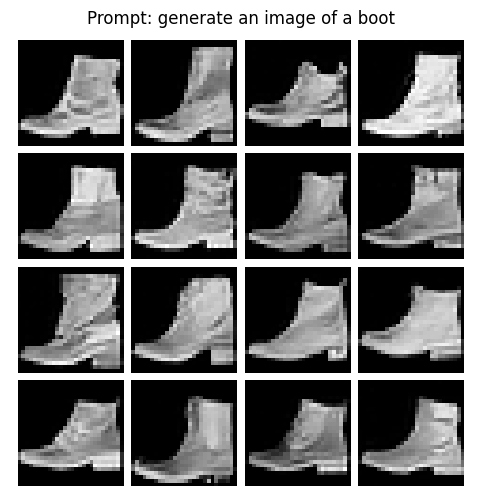
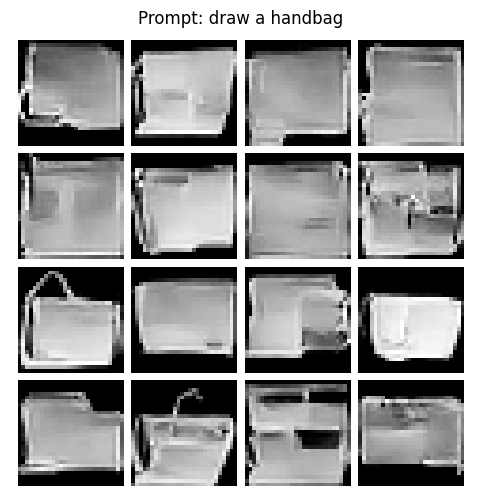
A conditional diffusion model replaces the unconditional denoiser \(\boldsymbol{\varepsilon}_\theta(\boldsymbol{x}_t,t)\) with a conditioned denoiser \(\boldsymbol{\varepsilon}_\theta(\boldsymbol{x}_t,t,\boldsymbol{c})\), where \(\boldsymbol{c}\) is a prompt embedding. This changes the modeling task in a precise way: the network learns to reverse Gaussian corruption while staying aligned with a requested semantic description. A prompt such as “generate an image of a boot” keeps pushing the reverse trajectory toward the region of the data distribution associated with ankle boots, while a prompt such as “draw a handbag” steers the same denoiser toward bags.
Classifier-free guidance sharpens this conditioning signal with the same network. During training, part of the minibatch is given a null prompt, so the network learns both conditional and unconditional behavior. During sampling, the two outputs are combined through
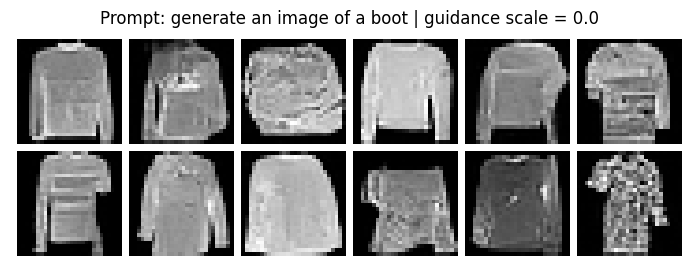
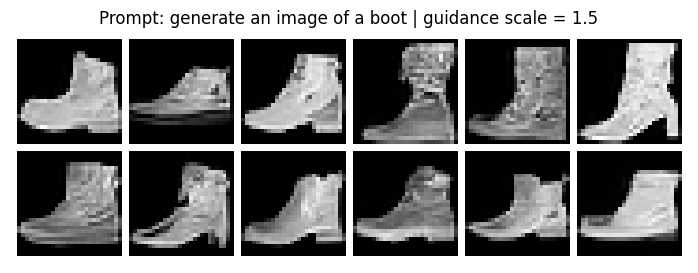
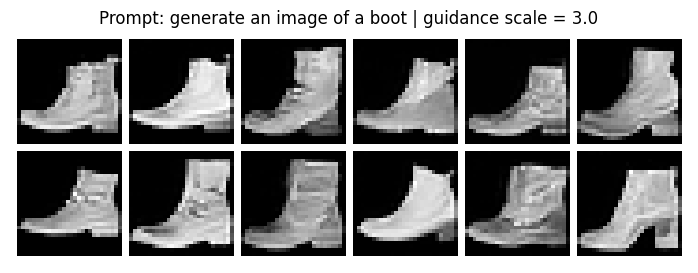
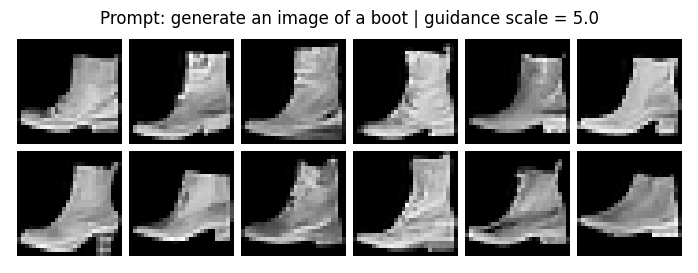
where \(\omega\) is the guidance scale. The equation says exactly what the sampler is doing: start from the unconditional denoising direction and move further toward the prompt-consistent direction. Larger guidance usually increases prompt alignment, although too much guidance can reduce diversity or create artifacts.
A Pretrained Tiny Text Encoder and a Prompt Corpus#
To make conditioning realistic, the prompt embeddings come from a pretrained tiny BERT encoder. This matches the structure used in modern image systems, where the text model and the image denoiser play different roles: the text encoder builds a semantic representation of the prompt, and the diffusion model learns how that representation should shape the reverse trajectory.
The prompt corpus is deliberately compact, since FashionMNIST has only ten semantic classes, but the prompts are written as short natural-language requests rather than as class IDs. Prompting then means exactly what it means in practice: text is tokenized, encoded by a language model, pooled into an embedding, and injected into the denoiser. The underlying language-encoder idea comes from pretrained transformer encoders such as BERT [DCLT19].
import math
import random
from pathlib import Path

import matplotlib.pyplot as plt
import torch
import torch.nn as nn
import torch.nn.functional as F
from torch.utils.data import DataLoader, Dataset
from torchmetrics.image.fid import FrechetInceptionDistance
from torchmetrics.image.kid import KernelInceptionDistance
from torchvision import datasets, transforms, utils
from tqdm.auto import tqdm
from transformers import AutoModel, AutoTokenizer

device = torch.device("cuda" if torch.cuda.is_available() else "cpu")
random.seed(7)
torch.manual_seed(7)
if device.type == "cuda":
    torch.cuda.manual_seed_all(7)

project_root = Path.cwd() if (Path.cwd() / "_config.yml").exists() else Path.cwd().parent
artifacts_dir = project_root / "artifacts"
artifacts_dir.mkdir(exist_ok=True)

batch_size = 128
metric_batch_size = 64
num_workers = 0
image_size = 28
channels = 1
timesteps = 300
base_channels = 64
time_dim = 128
text_dim = 128
conditional_epochs = 45
vae_epochs = 35
latent_diffusion_epochs = 45
condition_dropout = 0.15
latent_channels = 8
latent_scaling = 1.0  # placeholder; recomputed from the trained VAE latents below
text_model_name = "prajjwal1/bert-tiny"

transform = transforms.Compose([
    transforms.ToTensor(),
    transforms.Lambda(lambda x: 2.0 * x - 1.0),
])

train_dataset = datasets.FashionMNIST(root=project_root / "data", train=True, download=True, transform=transform)
test_dataset = datasets.FashionMNIST(root=project_root / "data", train=False, download=True, transform=transform)
class_names = train_dataset.classes
prompt_bank = {
    0: [
        "generate an image of a tshirt",
        "draw a casual tshirt",
        "show a short sleeve top",
    ],
    1: [
        "generate an image of trousers",
        "draw a pair of pants",
        "show a pair of trousers",
    ],
    2: [
        "generate an image of a pullover",
        "draw a knitted pullover",
        "show a warm sweater",
    ],
    3: [
        "generate an image of a dress",
        "draw a simple dress",
        "show a clothing dress",
    ],
    4: [
        "generate an image of a coat",
        "draw a long coat",
        "show a winter coat",
    ],
    5: [
        "generate an image of a sandal",
        "draw an open sandal",
        "show a summer sandal",
    ],
    6: [
        "generate an image of a shirt",
        "draw a collared shirt",
        "show a shirt garment",
    ],
    7: [
        "generate an image of a sneaker",
        "draw a sport sneaker",
        "show a sneaker shoe",
    ],
    8: [
        "generate an image of a bag",
        "draw a handbag",
        "show a fashion bag",
    ],
    9: [
        "generate an image of a boot",
        "draw an ankle boot",
        "show a boot shoe",
    ],
}

all_prompts = [prompt for prompts in prompt_bank.values() for prompt in prompts]
null_prompt = ""

class PromptedFashionDataset(Dataset):
    def __init__(self, base_dataset, prompt_bank):
        self.base_dataset = base_dataset
        self.prompt_bank = prompt_bank

    def __len__(self):
        return len(self.base_dataset)

    def __getitem__(self, idx):
        image, label = self.base_dataset[idx]
        prompt = random.choice(self.prompt_bank[label])
        return image, label, prompt


def prompt_collate(batch):
    images, labels, prompts = zip(*batch)
    images = torch.stack(images)
    labels = torch.tensor(labels, dtype=torch.long)
    return images, labels, list(prompts)


prompt_train_dataset = PromptedFashionDataset(train_dataset, prompt_bank)
prompt_test_dataset = PromptedFashionDataset(test_dataset, prompt_bank)

prompt_train_loader = DataLoader(
    prompt_train_dataset,
    batch_size=batch_size,
    shuffle=True,
    num_workers=num_workers,
    pin_memory=(device.type == "cuda"),
    collate_fn=prompt_collate,
)
prompt_test_loader = DataLoader(
    prompt_test_dataset,
    batch_size=batch_size,
    shuffle=False,
    num_workers=num_workers,
    pin_memory=(device.type == "cuda"),
    collate_fn=prompt_collate,
)
tokenizer = AutoTokenizer.from_pretrained(text_model_name, use_fast=False)
text_encoder = AutoModel.from_pretrained(text_model_name).to(device)
text_encoder.eval()
for parameter in text_encoder.parameters():
    parameter.requires_grad_(False)


def mean_pool(hidden_state, attention_mask):
    mask = attention_mask.unsqueeze(-1).float()
    masked = hidden_state * mask
    return masked.sum(dim=1) / mask.sum(dim=1).clamp(min=1.0)


@torch.no_grad()
def encode_prompts(prompts):
    encoded = tokenizer(
        prompts,
        padding=True,
        truncation=True,
        return_tensors="pt",
    )
    encoded = {key: value.to(device) for key, value in encoded.items()}
    outputs = text_encoder(**encoded)
    pooled = mean_pool(outputs.last_hidden_state, encoded["attention_mask"])
    return pooled


sample_prompt_embeddings = encode_prompts([
    "generate an image of a boot",
    "draw a handbag",
    "show a winter coat",
])
print(sample_prompt_embeddings.shape)
c:\Users\tivog\deep-generative-models\.venv\lib\site-packages\huggingface_hub\file_download.py:143: UserWarning: `huggingface_hub` cache-system uses symlinks by default to efficiently store duplicated files but your machine does not support them in C:\Users\tivog\.cache\huggingface\hub\models--prajjwal1--bert-tiny. Caching files will still work but in a degraded version that might require more space on your disk. This warning can be disabled by setting the `HF_HUB_DISABLE_SYMLINKS_WARNING` environment variable. For more details, see https://huggingface.co/docs/huggingface_hub/how-to-cache#limitations.
To support symlinks on Windows, you either need to activate Developer Mode or to run Python as an administrator. In order to activate developer mode, see this article: https://docs.microsoft.com/en-us/windows/apps/get-started/enable-your-device-for-development
  warnings.warn(message)
c:\Users\tivog\deep-generative-models\.venv\lib\site-packages\transformers\tokenization_utils_base.py:1601: FutureWarning: `clean_up_tokenization_spaces` was not set. It will be set to `True` by default. This behavior will be depracted in transformers v4.45, and will be then set to `False` by default. For more details check this issue: https://github.com/huggingface/transformers/issues/31884
  warnings.warn(
Asking to truncate to max_length but no maximum length is provided and the model has no predefined maximum length. Default to no truncation.
torch.Size([3, 128])
A Text-Conditioned Diffusion Denoiser#
The denoiser combines a sinusoidal time embedding with the pretrained prompt embedding. Architecturally this is simple: the prompt vector and the time vector are projected to the same dimension, added together, and injected into residual blocks throughout a compact U-Net. The important point is that the reverse dynamics now have access to a genuine semantic signal derived from text.
On FashionMNIST this is enough to make prompted generation concrete. The prompt “generate an image of a boot” is embedded by a frozen pretrained language model, and the diffusion model learns how to use that semantic vector during denoising.
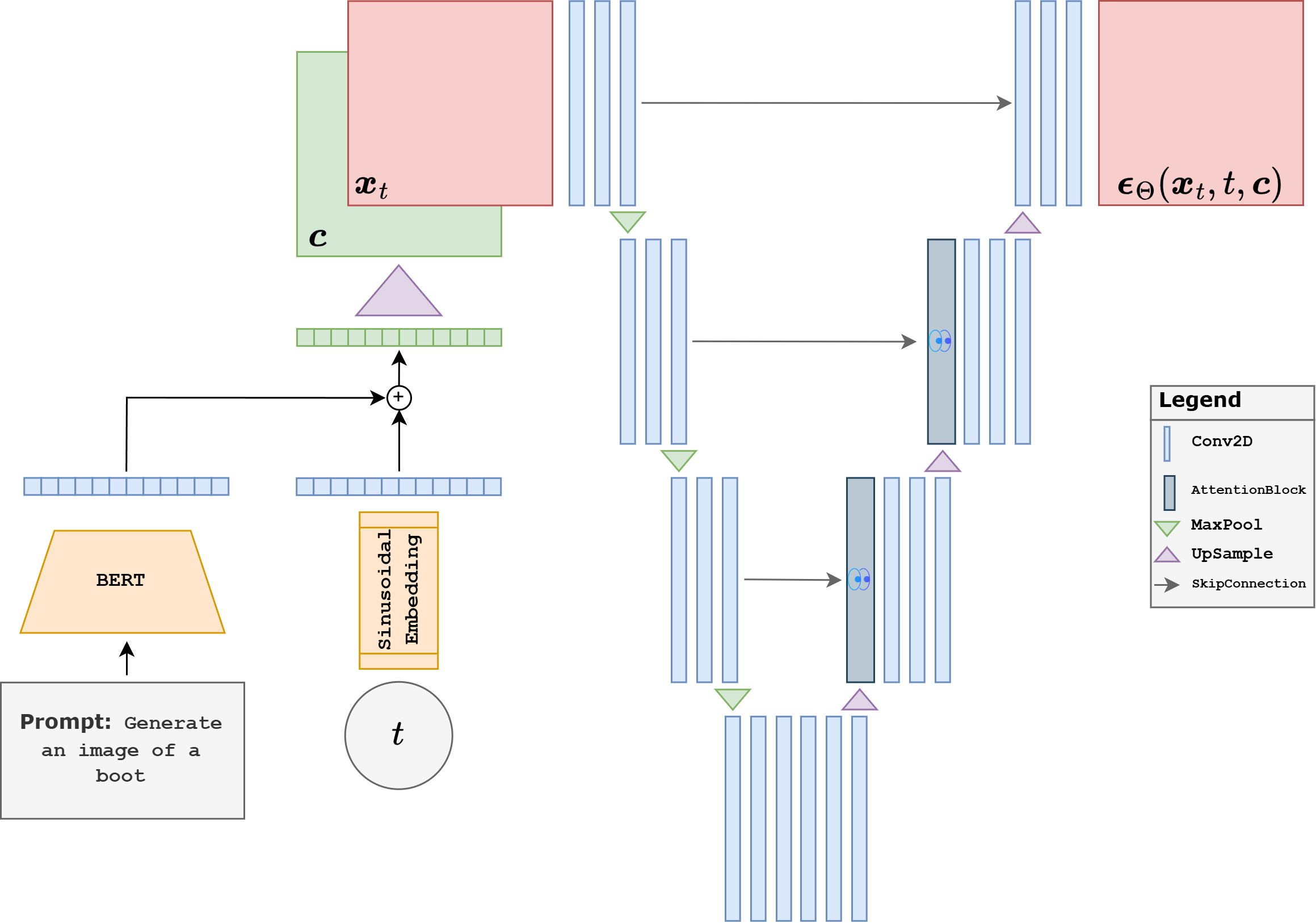
Fig. 44 A text-conditioned diffusion U-Net. The prompt embedding produced by the frozen text encoder is projected and combined with the time embedding, then injected into the residual blocks at several depths, so that every denoising step is steered by the requested semantics.#
betas = torch.linspace(1e-4, 0.02, timesteps, device=device)
bar_alphas = 1.0 - betas
alphas = torch.cumprod(bar_alphas, dim=0)
alphas_prev = torch.cat([torch.tensor([1.0], device=device), alphas[:-1]], dim=0)

sqrt_alphas = torch.sqrt(alphas)
sqrt_one_minus_alphas = torch.sqrt(1.0 - alphas)
sqrt_recip_bar_alphas = torch.sqrt(1.0 / bar_alphas)
posterior_variance = betas * (1.0 - alphas_prev) / (1.0 - alphas)


def extract(coefficients, t, x_shape):
    out = coefficients.gather(0, t)
    return out.view(t.shape[0], *((1,) * (len(x_shape) - 1)))


def q_sample(x0, t, noise=None):
    if noise is None:
        noise = torch.randn_like(x0)
    return (
        extract(sqrt_alphas, t, x0.shape) * x0
        + extract(sqrt_one_minus_alphas, t, x0.shape) * noise
    )


class SinusoidalTimeEmbedding(nn.Module):
    def __init__(self, dim):
        super().__init__()
        self.dim = dim

    def forward(self, t):
        half = self.dim // 2
        factor = math.log(10000.0) / max(half - 1, 1)
        frequencies = torch.exp(torch.arange(half, device=t.device) * -factor)
        angles = t.float().unsqueeze(1) * frequencies.unsqueeze(0)
        embedding = torch.cat([angles.sin(), angles.cos()], dim=1)
        if self.dim % 2 == 1:
            embedding = F.pad(embedding, (0, 1))
        return embedding


class ConditionalResidualBlock(nn.Module):
    def __init__(self, in_channels, out_channels, context_dim):
        super().__init__()
        self.norm1 = nn.GroupNorm(8, in_channels)
        self.conv1 = nn.Conv2d(in_channels, out_channels, kernel_size=3, padding=1)
        self.norm2 = nn.GroupNorm(8, out_channels)
        self.conv2 = nn.Conv2d(out_channels, out_channels, kernel_size=3, padding=1)
        self.context_proj = nn.Linear(context_dim, out_channels)
        self.skip = nn.Conv2d(in_channels, out_channels, kernel_size=1) if in_channels != out_channels else nn.Identity()

    def forward(self, x, context):
        h = self.conv1(F.silu(self.norm1(x)))
        h = h + self.context_proj(context)[:, :, None, None]
        h = self.conv2(F.silu(self.norm2(h)))
        return h + self.skip(x)


class TextConditionedUNet(nn.Module):
    def __init__(self, in_channels=1, base_channels=64, time_dim=128, text_dim=128):
        super().__init__()
        self.time_mlp = nn.Sequential(
            SinusoidalTimeEmbedding(time_dim),
            nn.Linear(time_dim, time_dim),
            nn.SiLU(),
            nn.Linear(time_dim, time_dim),
        )
        self.text_proj = nn.Sequential(
            nn.Linear(text_dim, time_dim),
            nn.SiLU(),
            nn.Linear(time_dim, time_dim),
        )
        self.input_conv = nn.Conv2d(in_channels, base_channels, kernel_size=3, padding=1)
        self.down1 = ConditionalResidualBlock(base_channels, base_channels, time_dim)
        self.downsample = nn.Conv2d(base_channels, base_channels * 2, kernel_size=4, stride=2, padding=1)
        self.mid1 = ConditionalResidualBlock(base_channels * 2, base_channels * 2, time_dim)
        self.mid2 = ConditionalResidualBlock(base_channels * 2, base_channels * 2, time_dim)
        self.upsample = nn.ConvTranspose2d(base_channels * 2, base_channels, kernel_size=4, stride=2, padding=1)
        self.up1 = ConditionalResidualBlock(base_channels * 2, base_channels, time_dim)
        self.output_conv = nn.Conv2d(base_channels, in_channels, kernel_size=3, padding=1)

    def forward(self, x, t, prompt_embedding):
        time_context = self.time_mlp(t)
        text_context = self.text_proj(prompt_embedding)
        context = time_context + text_context
        x0 = self.input_conv(x)
        x1 = self.down1(x0, context)
        x2 = self.downsample(x1)
        x2 = self.mid1(x2, context)
        x2 = self.mid2(x2, context)
        x3 = self.upsample(x2)
        x3 = torch.cat([x3, x1], dim=1)
        x3 = self.up1(x3, context)
        return self.output_conv(x3)


text_denoiser = TextConditionedUNet(in_channels=channels, base_channels=base_channels, time_dim=time_dim, text_dim=text_dim).to(device)
Training the Prompted Diffusion Model#
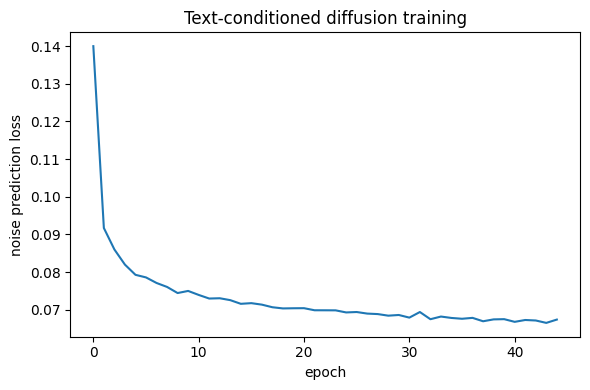
The training objective remains the standard DDPM noise-prediction loss. The prompt mechanism leaves the forward corruption law and the regression target unchanged; what it adds is the context available to the denoiser. Prompt dropout implements classifier-free guidance by replacing a fraction of the prompts with the empty string, which is then encoded by the same pretrained text encoder. The denoiser therefore learns an unconditional branch and a conditional branch inside a single network.
def apply_prompt_dropout(prompts, dropout_prob=0.0):
    if dropout_prob == 0.0:
        return prompts
    dropped = []
    for prompt in prompts:
        if random.random() < dropout_prob:
            dropped.append(null_prompt)
        else:
            dropped.append(prompt)
    return dropped


def conditional_diffusion_loss(model, images, prompts):
    t = torch.randint(0, timesteps, (images.size(0),), device=images.device).long()
    noise = torch.randn_like(images)
    xt = q_sample(images, t, noise=noise)
    prompt_embedding = encode_prompts(apply_prompt_dropout(prompts, dropout_prob=condition_dropout))
    pred_noise = model(xt, t, prompt_embedding)
    return F.mse_loss(pred_noise, noise)
text_denoiser_optimizer = torch.optim.Adam(text_denoiser.parameters(), lr=2e-4)
text_history = []

for epoch in range(conditional_epochs):
    text_denoiser.train()
    running = 0.0
    progress = tqdm(prompt_train_loader, desc=f"text diffusion epoch {epoch + 1}/{conditional_epochs}", leave=False)
    for images, labels, prompts in progress:
        images = images.to(device)
        loss = conditional_diffusion_loss(text_denoiser, images, prompts)

        text_denoiser_optimizer.zero_grad()
        loss.backward()
        text_denoiser_optimizer.step()

        running += loss.item() * images.size(0)
        progress.set_postfix(loss=f"{loss.item():.4f}")

    epoch_loss = running / len(prompt_train_loader.dataset)
    text_history.append(epoch_loss)
    print(f"epoch {epoch + 1:02d} | text diffusion loss = {epoch_loss:.4f}")

torch.save(
    {
        "denoiser": text_denoiser.state_dict(),
        "text_model_name": text_model_name,
    },
    artifacts_dir / "text_conditioned_diffusion_fashionmnist.pt",
)
epoch 01 | text diffusion loss = 0.1400
epoch 02 | text diffusion loss = 0.0917
epoch 03 | text diffusion loss = 0.0860
epoch 04 | text diffusion loss = 0.0820
epoch 05 | text diffusion loss = 0.0793
epoch 06 | text diffusion loss = 0.0786
epoch 07 | text diffusion loss = 0.0771
epoch 08 | text diffusion loss = 0.0760
epoch 09 | text diffusion loss = 0.0744
epoch 10 | text diffusion loss = 0.0750
epoch 11 | text diffusion loss = 0.0739
epoch 12 | text diffusion loss = 0.0730
epoch 13 | text diffusion loss = 0.0730
epoch 14 | text diffusion loss = 0.0725
epoch 15 | text diffusion loss = 0.0716
epoch 16 | text diffusion loss = 0.0717
epoch 17 | text diffusion loss = 0.0714
epoch 18 | text diffusion loss = 0.0707
epoch 19 | text diffusion loss = 0.0703
epoch 20 | text diffusion loss = 0.0704
epoch 21 | text diffusion loss = 0.0704
epoch 22 | text diffusion loss = 0.0699
epoch 23 | text diffusion loss = 0.0698
epoch 24 | text diffusion loss = 0.0698
epoch 25 | text diffusion loss = 0.0693
epoch 26 | text diffusion loss = 0.0694
epoch 27 | text diffusion loss = 0.0690
epoch 28 | text diffusion loss = 0.0688
epoch 29 | text diffusion loss = 0.0684
epoch 30 | text diffusion loss = 0.0686
epoch 31 | text diffusion loss = 0.0679
epoch 32 | text diffusion loss = 0.0694
epoch 33 | text diffusion loss = 0.0675
epoch 34 | text diffusion loss = 0.0682
epoch 35 | text diffusion loss = 0.0678
epoch 36 | text diffusion loss = 0.0676
epoch 37 | text diffusion loss = 0.0678
epoch 38 | text diffusion loss = 0.0669
epoch 39 | text diffusion loss = 0.0674
epoch 40 | text diffusion loss = 0.0675
epoch 41 | text diffusion loss = 0.0668
epoch 42 | text diffusion loss = 0.0673
epoch 43 | text diffusion loss = 0.0671
epoch 44 | text diffusion loss = 0.0665
epoch 45 | text diffusion loss = 0.0674
plt.figure(figsize=(6, 4))
plt.plot(text_history)
plt.xlabel("epoch")
plt.ylabel("noise prediction loss")
plt.title("Text-conditioned diffusion training")
plt.tight_layout()
plt.show()
Guided Sampling from Natural-Language Prompts#
At sampling time each prompt is encoded twice: once as written and once as the empty prompt. The two denoising predictions are mixed through the classifier-free guidance formula, which makes the effect of prompting visible in a concrete form. The conditioning vector here comes from a pretrained text encoder, whereas in class-conditioned diffusion it would come from a learned class embedding table.
@torch.no_grad()
def guided_text_sample(model, prompts, guidance_scale=4.0, show_progress=True):
    model.eval()
    cond_embedding = encode_prompts(prompts)
    uncond_embedding = encode_prompts([null_prompt] * len(prompts))

    x = torch.randn(len(prompts), channels, image_size, image_size, device=device)
    reverse_steps = reversed(range(timesteps))
    if show_progress:
        reverse_steps = tqdm(reverse_steps, total=timesteps, desc="guided text diffusion", leave=False)

    for t_scalar in reverse_steps:
        t = torch.full((len(prompts),), t_scalar, device=device, dtype=torch.long)
        eps_cond = model(x, t, cond_embedding)
        eps_uncond = model(x, t, uncond_embedding)
        pred_noise = eps_uncond + guidance_scale * (eps_cond - eps_uncond)

        beta_t = extract(betas, t, x.shape)
        sqrt_one_minus_alpha_t = extract(sqrt_one_minus_alphas, t, x.shape)
        sqrt_recip_bar_alpha_t = extract(sqrt_recip_bar_alphas, t, x.shape)
        model_mean = sqrt_recip_bar_alpha_t * (x - beta_t * pred_noise / sqrt_one_minus_alpha_t)

        if t_scalar > 0:
            variance = extract(posterior_variance, t, x.shape)
            x = model_mean + torch.sqrt(variance) * torch.randn_like(x)
        else:
            x = model_mean

    x = x.clamp(-1, 1)
    return 0.5 * (x + 1.0)
for title, prompts in [
    ("Prompt: generate an image of a boot", ["generate an image of a boot"] * 16),
    ("Prompt: draw a handbag", ["draw a handbag"] * 16),
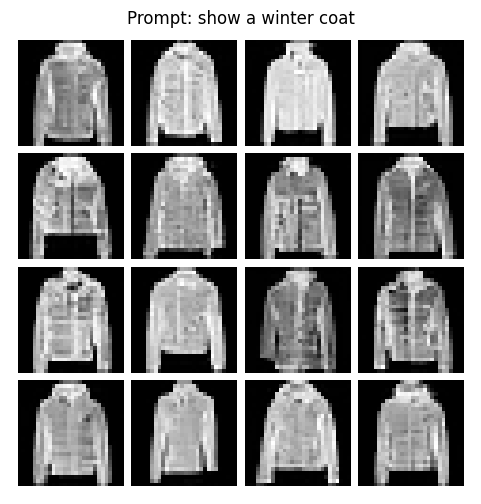
    ("Prompt: show a winter coat", ["show a winter coat"] * 16),
]:
    samples = guided_text_sample(text_denoiser, prompts, guidance_scale=4.0)
    plt.figure(figsize=(6, 6))
    plt.imshow(utils.make_grid(samples.cpu(), nrow=4, pad_value=1.0).permute(1, 2, 0), cmap="gray")
    plt.axis("off")
    plt.title(title)
    plt.show()
prompt = ["generate an image of a boot"] * 12
for scale in [0.0, 1.5, 3.0, 5.0]:
    samples = guided_text_sample(text_denoiser, prompt, guidance_scale=scale)
    plt.figure(figsize=(9, 3))
    plt.imshow(utils.make_grid(samples.cpu(), nrow=6, pad_value=1.0).permute(1, 2, 0), cmap="gray")
    plt.axis("off")
    plt.title(f"Prompt: generate an image of a boot | guidance scale = {scale}")
    plt.show()
Batched FID and KID for Prompted Pixel-Space Diffusion#
The quantitative evaluation keeps the prompt distribution used during training. Real-image features are accumulated once, while fake images are generated in manageable batches, so the metric computation stays memory-safe.
def prepare_for_metrics(images):
    if images.size(1) == 1:
        images = images.repeat(1, 3, 1, 1)
    return images.clamp(0.0, 1.0)


def sample_random_prompts(batch_n):
    prompts = []
    for _ in range(batch_n):
        label = random.randrange(len(prompt_bank))
        prompts.append(random.choice(prompt_bank[label]))
    return prompts


@torch.no_grad()
def compute_prompt_metrics(sample_fn, real_loader, num_fake=1000, metric_batch_size=64):
    fid = FrechetInceptionDistance(feature=2048, normalize=True, reset_real_features=False).to(device)
    kid = KernelInceptionDistance(subset_size=50, normalize=True, reset_real_features=False).to(device)

    real_seen = 0
    for images, _, _ in tqdm(real_loader, desc="real features", leave=False):
        images = images.to(device)
        if real_seen >= num_fake:
            break
        current = min(images.size(0), num_fake - real_seen)
        real_batch = prepare_for_metrics(0.5 * (images[:current] + 1.0))
        fid.update(real_batch, real=True)
        kid.update(real_batch, real=True)
        real_seen += current

    fake_seen = 0
    while fake_seen < num_fake:
        batch_n = min(metric_batch_size, num_fake - fake_seen)
        fake_images = sample_fn(sample_random_prompts(batch_n)).to(device)
        fake_batch = prepare_for_metrics(fake_images)
        fid.update(fake_batch, real=False)
        kid.update(fake_batch, real=False)
        fake_seen += batch_n

    kid_mean, kid_std = kid.compute()
    return {
        "fid": float(fid.compute().item()),
        "kid_mean": float(kid_mean.item()),
        "kid_std": float(kid_std.item()),
    }
pixel_prompt_metrics = compute_prompt_metrics(
    lambda prompts: guided_text_sample(text_denoiser, prompts, guidance_scale=4.0, show_progress=False),
    prompt_test_loader,
    num_fake=1000,
    metric_batch_size=metric_batch_size,
)
pixel_prompt_metrics
c:\Users\tivog\deep-generative-models\.venv\lib\site-packages\torchmetrics\utilities\prints.py:43: UserWarning: Metric `Kernel Inception Distance` will save all extracted features in buffer. For large datasets this may lead to large memory footprint.
  warnings.warn(*args, **kwargs)
{'fid': 44.040035247802734,
 'kid_mean': 0.006761453114449978,
 'kid_std': 0.0035809935070574284}
Latent Diffusion with a Variational Autoencoder#
A latent diffusion model denoises the latent representation produced by a separate generative model. Using a VAE is natural because the latent space is already organized probabilistically: the encoder maps images to a Gaussian posterior, the decoder maps latent samples back to image space, and the latent prior encourages a structured sampling geometry. Diffusion then operates in that representation.
This reshapes the computational problem. The denoiser works on a smaller latent tensor whose structure has already been partially regularized by the VAE, so it carries less of the burden of modeling local pixel correlations at full spatial resolution. The cost of sampling drops, and the decoder turns the final latent sample into an image. In modern systems this is one of the key reasons prompted generation becomes practical at larger resolutions.
Running diffusion in the latent space of an autoencoding model is the recipe popularized by latent diffusion models [RBL+22].
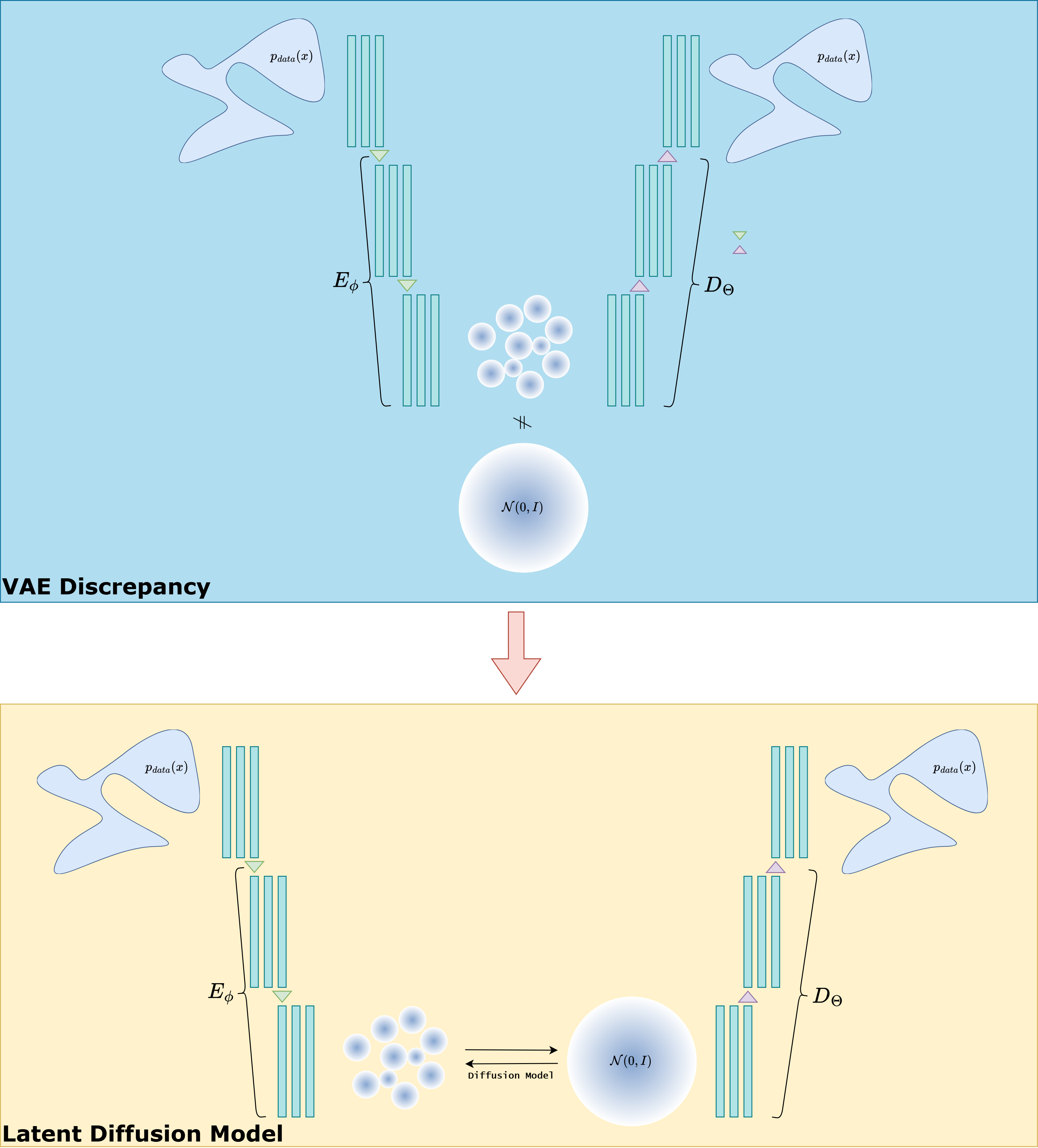
Fig. 45 Latent diffusion. The VAE encoder maps an image to a compact latent code, the diffusion forward and reverse processes run entirely in that latent space, and the VAE decoder turns the final denoised latent back into an image. Operating in the smaller latent space is what makes high-resolution prompted generation practical.#
Training a Convolutional VAE on FashionMNIST#
This VAE provides the latent space for the diffusion model. It is trained with a reconstruction term and a KL regularizer, in the same way as in the earlier VAE chapter, but in a compact convolutional form suited to FashionMNIST.
The weight on the KL term is the decisive hyperparameter here. A near-zero weight turns the VAE into a plain autoencoder: reconstructions are sharp, but the encoder collapses the posterior variance and packs high-frequency, noise-like detail into the code. That code lies on a thin, irregular manifold, and a decoder trained only on it is extremely sensitive, so any latent the diffusion model produces with a small error decodes to noise. A larger KL weight keeps the aggregate latent close to a standard Gaussian and forces the decoder to tolerate latent perturbations. The latent then becomes diffusable: samples drawn from a roughly Gaussian distribution decode to plausible garments, which is exactly what the latent diffusion model will feed the decoder at generation time.
class ConvVAE(nn.Module):
    def __init__(self, latent_channels=8):
        super().__init__()
        self.encoder = nn.Sequential(
            nn.Conv2d(1, 32, kernel_size=4, stride=2, padding=1),
            nn.SiLU(),
            nn.Conv2d(32, 64, kernel_size=4, stride=2, padding=1),
            nn.SiLU(),
            nn.Conv2d(64, 128, kernel_size=3, padding=1),
            nn.SiLU(),
        )
        self.mu_head = nn.Conv2d(128, latent_channels, kernel_size=3, padding=1)
        self.logvar_head = nn.Conv2d(128, latent_channels, kernel_size=3, padding=1)
        self.decoder = nn.Sequential(
            nn.Conv2d(latent_channels, 128, kernel_size=3, padding=1),
            nn.SiLU(),
            nn.ConvTranspose2d(128, 64, kernel_size=4, stride=2, padding=1),
            nn.SiLU(),
            nn.ConvTranspose2d(64, 32, kernel_size=4, stride=2, padding=1),
            nn.SiLU(),
            nn.Conv2d(32, 1, kernel_size=3, padding=1),
            nn.Tanh(),
        )

    def encode(self, x):
        h = self.encoder(x)
        return self.mu_head(h), self.logvar_head(h)

    def reparameterize(self, mu, logvar):
        std = torch.exp(0.5 * logvar)
        noise = torch.randn_like(std)
        return mu + std * noise

    def decode(self, z):
        return self.decoder(z)

    def forward(self, x):
        mu, logvar = self.encode(x)
        z = self.reparameterize(mu, logvar)
        recon = self.decode(z)
        return recon, mu, logvar


vae = ConvVAE(latent_channels=latent_channels).to(device)
def vae_loss(x, recon, mu, logvar, beta=1e-2):
    recon_loss = F.l1_loss(recon, x) + F.mse_loss(recon, x)
    kl = -0.5 * torch.mean(1 + logvar - mu.pow(2) - logvar.exp())
    return recon_loss + beta * kl, recon_loss, kl


vae_optimizer = torch.optim.Adam(vae.parameters(), lr=2e-4)
vae_history = []
base_train_loader = DataLoader(train_dataset, batch_size=batch_size, shuffle=True, num_workers=num_workers, pin_memory=(device.type == "cuda"))
base_test_loader = DataLoader(test_dataset, batch_size=batch_size, shuffle=False, num_workers=num_workers, pin_memory=(device.type == "cuda"))

for epoch in range(vae_epochs):
    vae.train()
    running = 0.0
    progress = tqdm(base_train_loader, desc=f"vae epoch {epoch + 1}/{vae_epochs}", leave=False)
    for images, _ in progress:
        images = images.to(device)
        recon, mu, logvar = vae(images)
        loss, recon_loss, kl = vae_loss(images, recon, mu, logvar)

        vae_optimizer.zero_grad()
        loss.backward()
        vae_optimizer.step()

        running += loss.item() * images.size(0)
        progress.set_postfix(recon=f"{recon_loss.item():.4f}", kl=f"{kl.item():.4f}")

    epoch_loss = running / len(base_train_loader.dataset)
    vae_history.append(epoch_loss)
    print(f"epoch {epoch + 1:02d} | vae loss = {epoch_loss:.4f}")

torch.save(vae.state_dict(), artifacts_dir / "fashionmnist_ldm_vae.pt")


@torch.no_grad()
def estimate_latent_scaling(vae, loader, max_batches=20):
    vae.eval()
    collected = []
    for i, (images, _) in enumerate(loader):
        mu, _ = vae.encode(images.to(device))
        collected.append(mu.flatten())
        if i + 1 >= max_batches:
            break
    return torch.cat(collected).std().item()


# Standardize the diffusion latents to roughly unit variance. The fixed 0.18215
# constant only fits the Stable Diffusion autoencoder; a VAE trained from scratch
# needs its own measured scale. Without it the forward process never reaches an
# approximately N(0, I) state, and sampling from Gaussian noise produces garbage.
latent_scaling = estimate_latent_scaling(vae, base_train_loader)
print(f"latent scaling (empirical std of VAE means) = {latent_scaling:.4f}")
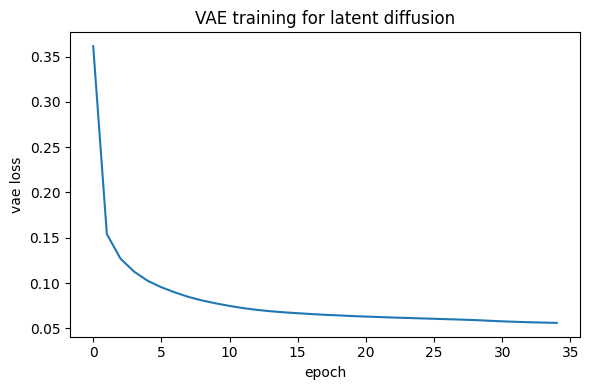
epoch 01 | vae loss = 0.3616
epoch 02 | vae loss = 0.1542
epoch 03 | vae loss = 0.1270
epoch 04 | vae loss = 0.1126
epoch 05 | vae loss = 0.1025
epoch 06 | vae loss = 0.0954
epoch 07 | vae loss = 0.0897
epoch 08 | vae loss = 0.0846
epoch 09 | vae loss = 0.0807
epoch 10 | vae loss = 0.0776
epoch 11 | vae loss = 0.0748
epoch 12 | vae loss = 0.0723
epoch 13 | vae loss = 0.0704
epoch 14 | vae loss = 0.0689
epoch 15 | vae loss = 0.0677
epoch 16 | vae loss = 0.0667
epoch 17 | vae loss = 0.0658
epoch 18 | vae loss = 0.0649
epoch 19 | vae loss = 0.0643
epoch 20 | vae loss = 0.0636
epoch 21 | vae loss = 0.0630
epoch 22 | vae loss = 0.0625
epoch 23 | vae loss = 0.0619
epoch 24 | vae loss = 0.0615
epoch 25 | vae loss = 0.0610
epoch 26 | vae loss = 0.0606
epoch 27 | vae loss = 0.0601
epoch 28 | vae loss = 0.0596
epoch 29 | vae loss = 0.0591
epoch 30 | vae loss = 0.0584
epoch 31 | vae loss = 0.0577
epoch 32 | vae loss = 0.0572
epoch 33 | vae loss = 0.0567
epoch 34 | vae loss = 0.0564
epoch 35 | vae loss = 0.0560
latent scaling (empirical std of VAE means) = 0.8314
plt.figure(figsize=(6, 4))
plt.plot(vae_history)
plt.xlabel("epoch")
plt.ylabel("vae loss")
plt.title("VAE training for latent diffusion")
plt.tight_layout()
plt.show()

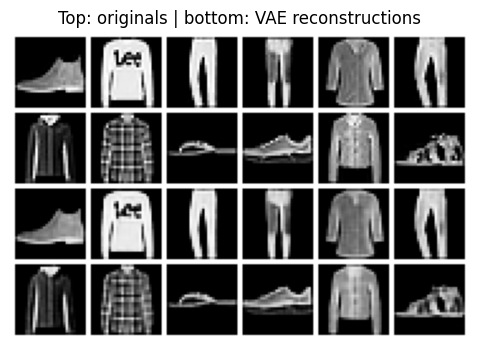
vae.eval()
images, _ = next(iter(base_test_loader))
images = images[:12].to(device)
with torch.no_grad():
    recon, mu, logvar = vae(images)

visual = torch.cat([0.5 * (images + 1.0), 0.5 * (recon + 1.0)], dim=0)
plt.figure(figsize=(10, 4))
plt.imshow(utils.make_grid(visual.cpu(), nrow=6, pad_value=1.0).permute(1, 2, 0), cmap="gray")
plt.axis("off")
plt.title("Top: originals | bottom: VAE reconstructions")
plt.show()
Text-Conditioned Diffusion in VAE Latent Space#
The latent denoiser uses the same pretrained prompt embeddings as the pixel-space model, now operating on latent tensors produced by the VAE encoder. The VAE mean is divided by an empirical scale factor, measured as the standard deviation of the encoder means over the training set, so that the diffusion latents have roughly unit variance. This standardization matters: the variance-preserving schedule assumes data near unit scale, and without it the forward process never reaches an approximately Gaussian state, so sampling from noise yields unusable images. After the reverse process finishes, the final latent sample is rescaled by the same factor and decoded back to image space by the VAE decoder. This is the full latent diffusion pattern in compact form: a text encoder provides semantic conditioning, a diffusion model shapes latent samples, and a VAE decoder turns them into images.
class LatentTextConditionedUNet(nn.Module):
    def __init__(self, latent_channels=8, base_channels=96, time_dim=128, text_dim=128):
        super().__init__()
        self.time_mlp = nn.Sequential(
            SinusoidalTimeEmbedding(time_dim),
            nn.Linear(time_dim, time_dim),
            nn.SiLU(),
            nn.Linear(time_dim, time_dim),
        )
        self.text_proj = nn.Sequential(
            nn.Linear(text_dim, time_dim),
            nn.SiLU(),
            nn.Linear(time_dim, time_dim),
        )
        self.input_conv = nn.Conv2d(latent_channels, base_channels, kernel_size=3, padding=1)
        self.down1 = ConditionalResidualBlock(base_channels, base_channels, time_dim)
        self.downsample = nn.Conv2d(base_channels, base_channels * 2, kernel_size=4, stride=2, padding=1)
        self.mid1 = ConditionalResidualBlock(base_channels * 2, base_channels * 2, time_dim)
        self.mid2 = ConditionalResidualBlock(base_channels * 2, base_channels * 2, time_dim)
        self.upsample = nn.ConvTranspose2d(base_channels * 2, base_channels, kernel_size=4, stride=2, padding=1, output_padding=1)
        self.up1 = ConditionalResidualBlock(base_channels * 2, base_channels, time_dim)
        self.output_conv = nn.Conv2d(base_channels, latent_channels, kernel_size=3, padding=1)

    def forward(self, z, t, prompt_embedding):
        time_context = self.time_mlp(t)
        text_context = self.text_proj(prompt_embedding)
        context = time_context + text_context
        z0 = self.input_conv(z)
        z1 = self.down1(z0, context)
        z2 = self.downsample(z1)
        z2 = self.mid1(z2, context)
        z2 = self.mid2(z2, context)
        z3 = self.upsample(z2)
        z3 = torch.cat([z3, z1], dim=1)
        z3 = self.up1(z3, context)
        return self.output_conv(z3)


latent_denoiser = LatentTextConditionedUNet(latent_channels=latent_channels, base_channels=96, time_dim=time_dim, text_dim=text_dim).to(device)
@torch.no_grad()
def encode_latents(images):
    mu, logvar = vae.encode(images)
    return mu / latent_scaling


def latent_diffusion_loss(model, images, prompts):
    with torch.no_grad():
        latents = encode_latents(images)
        prompt_embedding = encode_prompts(apply_prompt_dropout(prompts, dropout_prob=condition_dropout))
    t = torch.randint(0, timesteps, (images.size(0),), device=images.device).long()
    noise = torch.randn_like(latents)
    zt = q_sample(latents, t, noise=noise)
    pred_noise = model(zt, t, prompt_embedding)
    return F.mse_loss(pred_noise, noise)
latent_optimizer = torch.optim.Adam(latent_denoiser.parameters(), lr=2e-4)
latent_history = []
vae.eval()

for epoch in range(latent_diffusion_epochs):
    latent_denoiser.train()
    running = 0.0
    progress = tqdm(prompt_train_loader, desc=f"latent diffusion epoch {epoch + 1}/{latent_diffusion_epochs}", leave=False)
    for images, labels, prompts in progress:
        images = images.to(device)
        loss = latent_diffusion_loss(latent_denoiser, images, prompts)

        latent_optimizer.zero_grad()
        loss.backward()
        latent_optimizer.step()

        running += loss.item() * images.size(0)
        progress.set_postfix(loss=f"{loss.item():.4f}")

    epoch_loss = running / len(prompt_train_loader.dataset)
    latent_history.append(epoch_loss)
    print(f"epoch {epoch + 1:02d} | latent diffusion loss = {epoch_loss:.4f}")

torch.save(latent_denoiser.state_dict(), artifacts_dir / "fashionmnist_latent_text_diffusion.pt")
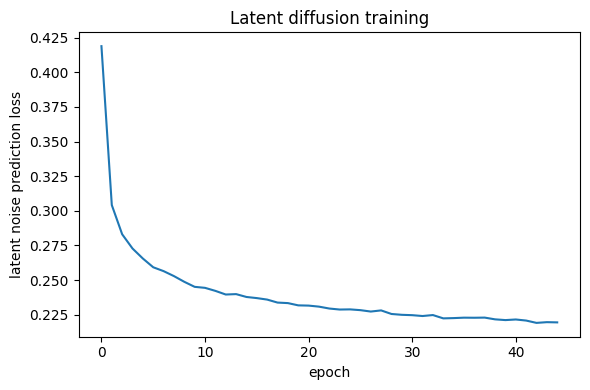
epoch 01 | latent diffusion loss = 0.4188
epoch 02 | latent diffusion loss = 0.3041
epoch 03 | latent diffusion loss = 0.2830
epoch 04 | latent diffusion loss = 0.2727
epoch 05 | latent diffusion loss = 0.2655
epoch 06 | latent diffusion loss = 0.2592
epoch 07 | latent diffusion loss = 0.2564
epoch 08 | latent diffusion loss = 0.2528
epoch 09 | latent diffusion loss = 0.2487
epoch 10 | latent diffusion loss = 0.2451
epoch 11 | latent diffusion loss = 0.2443
epoch 12 | latent diffusion loss = 0.2422
epoch 13 | latent diffusion loss = 0.2395
epoch 14 | latent diffusion loss = 0.2398
epoch 15 | latent diffusion loss = 0.2378
epoch 16 | latent diffusion loss = 0.2369
epoch 17 | latent diffusion loss = 0.2359
epoch 18 | latent diffusion loss = 0.2337
epoch 19 | latent diffusion loss = 0.2333
epoch 20 | latent diffusion loss = 0.2317
epoch 21 | latent diffusion loss = 0.2315
epoch 22 | latent diffusion loss = 0.2308
epoch 23 | latent diffusion loss = 0.2294
epoch 24 | latent diffusion loss = 0.2287
epoch 25 | latent diffusion loss = 0.2288
epoch 26 | latent diffusion loss = 0.2282
epoch 27 | latent diffusion loss = 0.2272
epoch 28 | latent diffusion loss = 0.2281
epoch 29 | latent diffusion loss = 0.2255
epoch 30 | latent diffusion loss = 0.2249
epoch 31 | latent diffusion loss = 0.2246
epoch 32 | latent diffusion loss = 0.2240
epoch 33 | latent diffusion loss = 0.2247
epoch 34 | latent diffusion loss = 0.2223
epoch 35 | latent diffusion loss = 0.2225
epoch 36 | latent diffusion loss = 0.2228
epoch 37 | latent diffusion loss = 0.2228
epoch 38 | latent diffusion loss = 0.2229
epoch 39 | latent diffusion loss = 0.2216
epoch 40 | latent diffusion loss = 0.2211
epoch 41 | latent diffusion loss = 0.2215
epoch 42 | latent diffusion loss = 0.2207
epoch 43 | latent diffusion loss = 0.2190
epoch 44 | latent diffusion loss = 0.2196
epoch 45 | latent diffusion loss = 0.2194
plt.figure(figsize=(6, 4))
plt.plot(latent_history)
plt.xlabel("epoch")
plt.ylabel("latent noise prediction loss")
plt.title("Latent diffusion training")
plt.tight_layout()
plt.show()
Sampling from Text Prompts in Latent Space#
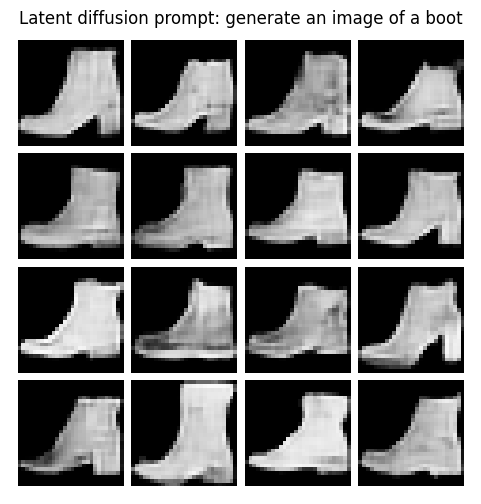
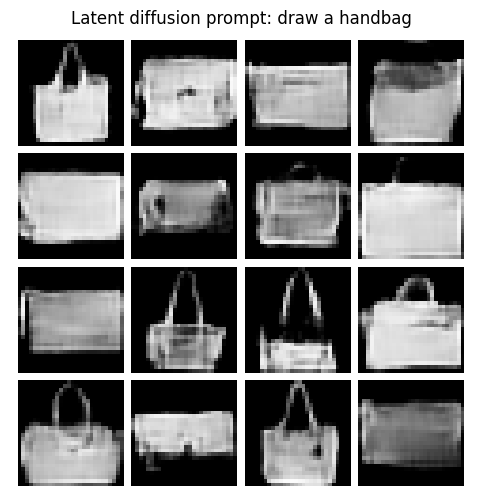
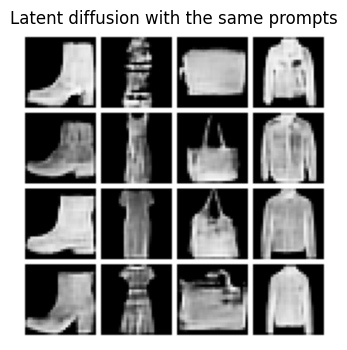
The latent sampler mirrors the pixel-space sampler, with the reverse process running on latent tensors and the final denoised latent decoded by the VAE. Using the same prompt embeddings in both settings keeps the comparison between pixel-space and latent-space denoising transparent.
@torch.no_grad()
def guided_latent_text_sample(model, prompts, guidance_scale=4.0, show_progress=True):
    model.eval()
    vae.eval()
    cond_embedding = encode_prompts(prompts)
    uncond_embedding = encode_prompts([null_prompt] * len(prompts))

    z = torch.randn(len(prompts), latent_channels, 7, 7, device=device)
    reverse_steps = reversed(range(timesteps))
    if show_progress:
        reverse_steps = tqdm(reverse_steps, total=timesteps, desc="guided latent diffusion", leave=False)

    for t_scalar in reverse_steps:
        t = torch.full((len(prompts),), t_scalar, device=device, dtype=torch.long)
        eps_cond = model(z, t, cond_embedding)
        eps_uncond = model(z, t, uncond_embedding)
        pred_noise = eps_uncond + guidance_scale * (eps_cond - eps_uncond)

        beta_t = extract(betas, t, z.shape)
        sqrt_one_minus_alpha_t = extract(sqrt_one_minus_alphas, t, z.shape)
        sqrt_recip_bar_alpha_t = extract(sqrt_recip_bar_alphas, t, z.shape)
        model_mean = sqrt_recip_bar_alpha_t * (z - beta_t * pred_noise / sqrt_one_minus_alpha_t)

        if t_scalar > 0:
            variance = extract(posterior_variance, t, z.shape)
            z = model_mean + torch.sqrt(variance) * torch.randn_like(z)
        else:
            z = model_mean

    decoded = vae.decode(z * latent_scaling).clamp(-1, 1)
    return 0.5 * (decoded + 1.0)
for title, prompts in [
    ("Latent diffusion prompt: generate an image of a boot", ["generate an image of a boot"] * 16),
    ("Latent diffusion prompt: draw a handbag", ["draw a handbag"] * 16),
]:
    samples = guided_latent_text_sample(latent_denoiser, prompts, guidance_scale=4.0)
    plt.figure(figsize=(6, 6))
    plt.imshow(utils.make_grid(samples.cpu(), nrow=4, pad_value=1.0).permute(1, 2, 0), cmap="gray")
    plt.axis("off")
    plt.title(title)
    plt.show()
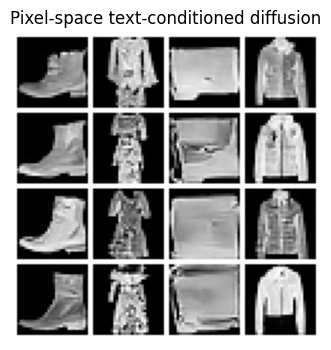
comparison_prompts = [
    "generate an image of a boot",
    "generate an image of a dress",
    "draw a handbag",
    "show a winter coat",
] * 4

pixel_samples = guided_text_sample(text_denoiser, comparison_prompts, guidance_scale=4.0, show_progress=False)
latent_samples = guided_latent_text_sample(latent_denoiser, comparison_prompts, guidance_scale=4.0, show_progress=False)

for title, samples in [
    ("Pixel-space text-conditioned diffusion", pixel_samples),
    ("Latent diffusion with the same prompts", latent_samples),
]:
    plt.figure(figsize=(10, 4))
    plt.imshow(utils.make_grid(samples.cpu(), nrow=4, pad_value=1.0).permute(1, 2, 0), cmap="gray")
    plt.axis("off")
    plt.title(title)
    plt.show()
Batched FID and KID for Latent Diffusion#
The latent model is evaluated with the same prompt distribution as the pixel-space model. The metric code stays unchanged except for the sampling function.
latent_prompt_metrics = compute_prompt_metrics(
    lambda prompts: guided_latent_text_sample(latent_denoiser, prompts, guidance_scale=4.0, show_progress=False),
    prompt_test_loader,
    num_fake=1000,
    metric_batch_size=metric_batch_size,
)
latent_prompt_metrics
{'fid': 41.00313186645508,
 'kid_mean': 0.012751836329698563,
 'kid_std': 0.006104985252022743}